

Wieson Technologies Announces H1 2026 Operational Results
H1 2026 Operational Results
Consolidated Revenue
1.56Billion NTD
Gross Margin
21%
EPS
0.13NTD
H2 Outlook: Focusing on AI Thermal Solutions and Robotics!
The changes in revenue and profitability in the first half of the year were primarily impacted by the decline in China's domestic automotive market. In the smart electronics segment, memory production shifted significantly toward AI applications, causing costs to surge. To manage expenses, customers reduced their orders for our smart electronic components, while chip supply shortages led to delayed customer shipments. Despite these external challenges, the company successfully maintained a gross margin of over 20% through strict cost control and product mix optimization, laying a solid foundation for H2 operations and technology development.
Looking ahead to the second half of 2026, as AI technology gradually expands from cloud computing to physical edge devices, the global robotics market and AI server demand are entering a phase of technological upgrade. Wieson Technologies will increase its R&D investment in three major new business areas: robotics, thermal management, and high-frequency/high-speed applications. R&D expenses will be raised to approximately 7% of revenue to strengthen product deployment and technological advancement.
Robotics Market: Integrating Four Key Technologies
With the deepening of industrial automation, AI, autonomous mobile robots (AMR), and humanoid robots are gradually moving from R&D validation into factories, logistics, and service environments. This trend drives the demand for related components to be highly reliable, high-speed, high-power, and highly integrated. Wieson Technologies will strategically position itself with "Connection × Data × Power × Thermal" as its core, focusing on key applications such as robot joints, motor drives, sensors, controllers, machine vision, and edge AI computing. The company will enhance its signal, power, and communication connection solutions, while extending its high-speed data transmission and thermal management technologies to meet the real-time computing, precise control, and long-term stability requirements of next-generation robots. By integrating these four technical capabilities, Wieson plans to evolve from a single-component supplier to an integrated solution provider, continuing to expand its presence in the industrial, mobile, and humanoid robotics markets.
Advanced Thermal Management Division: Developing Diverse AI Cooling Solutions
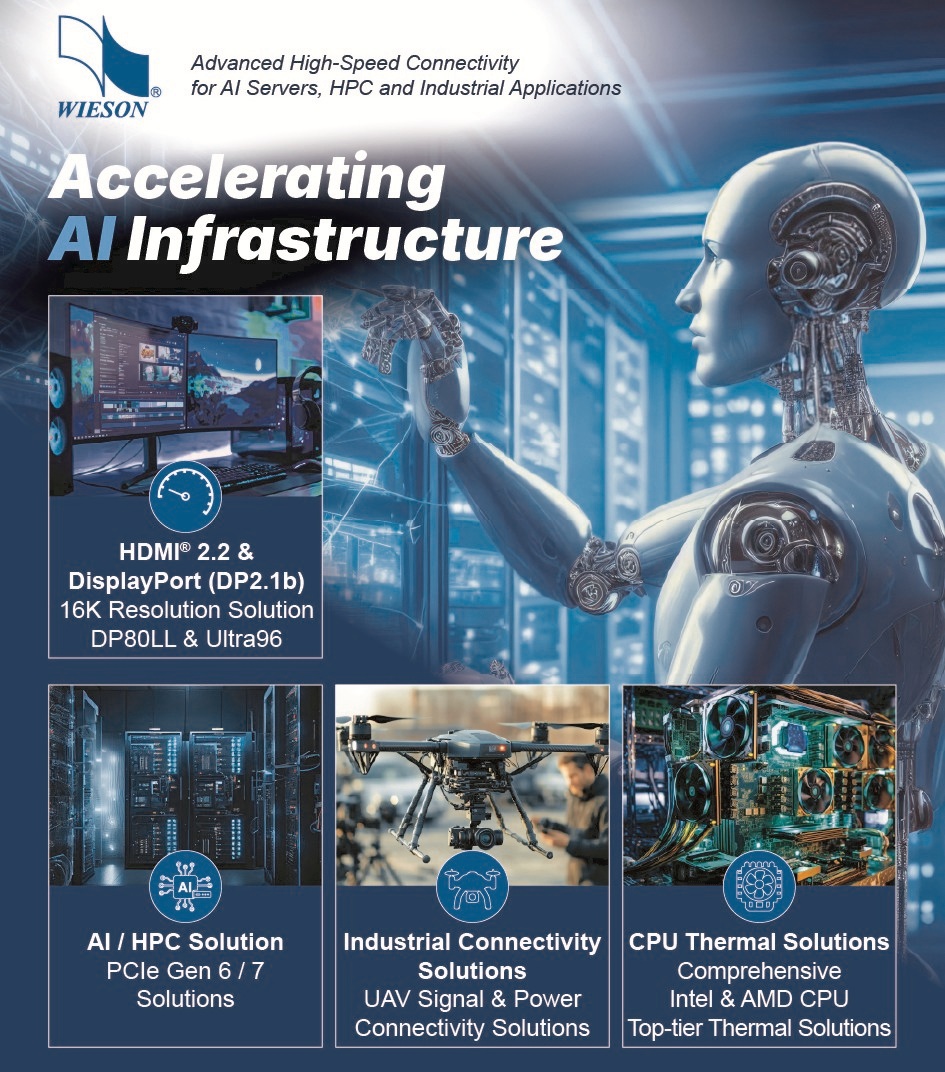
Currently, High Bandwidth Memory (HBM) for AI servers is consuming a massive amount of wafer capacity, and memory suppliers are shifting their focus to enterprise-grade products. This has caused a structural shortage of consumer-grade GDDR video memory, affecting PC and laptop shipments and increasing PC costs. In response to market changes, Wieson's Thermal Management Division continues to advance its technology development. For the Intel LGA9324 series CPUs and AMD SP8 series CPUs scheduled for release in Q4 2026, Wieson has already completed the testing and validation of corresponding server CPU thermal management solutions. Furthermore, addressing the cooling requirements for PCIe and OAM architecture GPUs or ASICs in AI computing, the R&D team provides customized thermal simulation analysis and develops both active and passive cooling modules. To meet the thermal management target of up to 800W for next-generation consumer graphics cards, Wieson has also developed air-cooling and AIO liquid cooling modules (WATERCOOLER), offering customers a diverse range of cooling options.
High-Speed Interconnect Division: Developing High-Speed and Highly Reliable Applications
Wieson continues to invest in high-frequency and high-speed product development and automated production process upgrades for the Server, Storage, IPC, and HPC markets. To further upgrade its high-speed transmission connector analysis and manufacturing technologies, the company has invested in 67G high-frequency network analyzers and automated testing equipment. This ensures compliance with customers' strict requirements for signal stability and data transmission speed across different application environments, providing highly stable and low-loss product options, and assisting customers in the smooth development and mass production of next-generation products.
Overall, Wieson Technologies will maintain stable financial operations and R&D resource investments. By integrating connection, data, power, and thermal technologies, the company will continue to monitor market demands and provide technical solutions that align with the trends of AI and smart manufacturing, striving to meet the product development and application needs of global customers in the second half of the year.
Download Drowing
Please enter your E-mail to download drowing, thanks!